We drive guests from Dubrovnik to Trebinje most weeks of the year — for day trips, wine tastings at Tvrdoš monastery, and as part of longer routes into Bosnia. It’s one of the most useful day trips out of Dubrovnik that almost no first-time visitor knows about. This is the practical guide we’d give a friend planning the same drive.
The route is short — about 45 km — but it crosses an international border and runs through limestone hill country, so timing and paperwork matter more than the distance suggests.
Quick facts
- Distance: ~45 km via Ivanica, ~63 km via Konjsko
- Drive time: 1 h 15 min via Ivanica, 1 h 40 min via Konjsko
- Border crossings: Ivanica (small, fast) or Konjsko (busier, on the main road to Montenegro)
- Currency: Bosnian Convertible Mark (BAM); euros widely accepted in tourist places at roughly 2 BAM = €1
- Time zone: Same as Croatia (CET/CEST)
- Language: Serbian (Cyrillic and Latin both used); English fine in restaurants and shops
- Passport: Required for everyone, including EU citizens
The two routes — which border crossing to use
There are two practical ways to drive from Dubrovnik to Trebinje. We use Ivanica almost always.
Ivanica (recommended). The shortest and quickest. You leave Dubrovnik heading northeast through the village of Ivanica, hit a small border post that’s rarely busy, and you’re in Bosnia. The Bosnian side of the road is single-carriageway through hills and small villages until you reach Trebinje. We can do this drive in about 1 hour 15 minutes, sometimes less, with a fast border. The crossing itself usually takes under 10 minutes outside peak summer.
Konjsko. Longer, both in distance and time. You’d take this if you’re combining Trebinje with a stop in the Konavle region or coming from the southern side of Dubrovnik. The crossing is on the main road to Herceg Novi (Montenegro), which means it can back up badly in July and August. We rarely recommend it for a direct Trebinje run.
If you’re going to Trebinje on a day when the Konavle wineries or Cavtat are also on your list, sometimes Konjsko makes sense. Otherwise, Ivanica wins.
Border crossing — what to expect
Bosnia and Herzegovina is not in the EU and not in Schengen, so this is a real international border with passport control on both sides. Live border-wait estimates and traffic info are published on the Croatian Auto Club (HAK) site.
- Passports. Required for everyone in the car, regardless of nationality. EU national ID cards alone do not work for non-EU citizens, and even some EU rules can be inconsistently applied — bring a passport.
- Green Card. The car must have insurance valid for Bosnia. Croatian rental cars usually do; check the rental documents before you go. Our vehicles all carry the extended Green Card and we’ve never had an issue.
- Vignettes/tolls. No toll on the Ivanica route. No vignette required in Bosnia for short visits, though one is required in some other parts of the country if you go further.
- Car declaration. Standard process. Border officers check passports, occasionally glance at the vehicle papers, and wave you through.
The border can get slow in mid-July and August, particularly between 10:00 and 13:00 when day-trip tour buses cluster. We aim to leave Dubrovnik by 8:30 or after 14:00 to avoid the worst of it.
Dubrovnik to Trebinje transfer
How much it costs to get there
Realistic 2026 prices for the same one-way trip:
- Private transfer (booked in advance): €110-€150 one way for a sedan, €130-€180 for a minivan. Round trip with 4-5 hours of waiting in Trebinje runs €200-€280.
- Local Dubrovnik taxi: €80-€120 each way, if you find one willing to cross. Many won’t, and the few that do often quote on the spot.
- Rental car: €40-€80 per day for the car, plus fuel (~€20 round trip), plus the cross-border surcharge most rental companies add (€20-€40), plus potential insurance gap. Total often ends up similar to a transfer once you add it all up.
- Public transport: No reliable direct bus. Indirect routes via Herceg Novi or Mostar cost €15-€25 but take 4-6 hours each way and rarely line up well for a day trip.
For a family or a couple who want a relaxed day, a pre-booked private transfer with waiting time is usually the best balance of cost and stress.
What’s worth seeing in Trebinje
Trebinje is small enough to cover on foot in half a day, with one or two short drives outside town for the bigger sights.
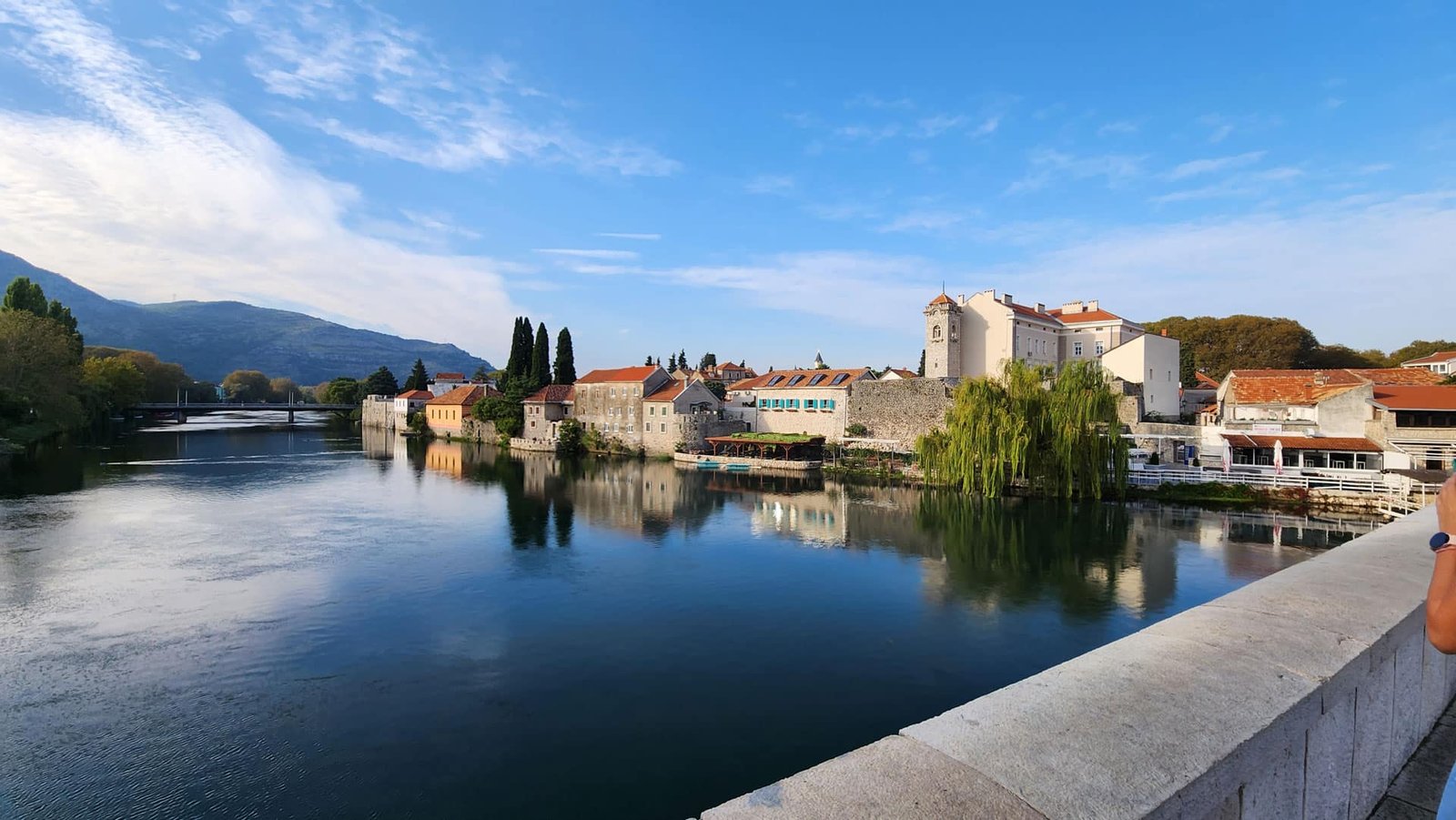
Old Town and main square. The walled old town is compact, easy to walk, and the central square is shaded by enormous old plane trees. Mornings have the local market with cheese, honey, sljivovica and seasonal fruit. We park clients near the square and meet back here after lunch.
Arslanagić Bridge. An Ottoman bridge built in 1574 by Mehmed-paša Sokolović. Submerged when the Trebišnjica hydropower reservoir was filled in 1965, dismantled in 1966 and reassembled stone by stone in its current location in the early 1970s. Nine arches with two larger main spans, photogenic, ten minutes is enough to see it. Just east of the centre.
Tvrdoš Monastery. About 5 km west of town. A working Serbian Orthodox monastery built around 1509 on the foundations of a 4th-century church (visible through a glass floor inside). Destroyed by the Venetians in 1694 and rebuilt in the 20th century. The monks make wine — Vranac, Cabernet, Žilavka — and tastings in the cellar are bookable for a few euros. We bring guests here whenever the day allows.
Hercegovačka Gračanica. On Crkvina hill above the city, a near-replica of the famous 14th-century Gračanica monastery in Kosovo, finished in 2000. The hilltop has the best panoramic view of Trebinje and the surrounding valley.
Wineries beyond Tvrdoš. The Trebinje area produces some serious Vranac and Žilavka. Vinarija Vukoje right in town has a tasting room. Several smaller producers up the valley do appointments only — we can call ahead if a wine day is what you want.
What catches travellers off guard at the border
- Forgetting passports. We’ve had to turn around at the border twice this year. Always check before pickup.
- Bringing only euros and assuming everywhere takes them. Tourist places do, smaller shops and the market often don’t — bring a small amount of BAM or use a card.
- Trying to combine Trebinje and Mostar in one day. Mostar is a separate, longer trip. Doing both means 8-10 hours of driving and rushing through both. Pick one.
- Going on Sunday with monastery plans. Tvrdoš is open Sundays but has services in the morning. Visit after 11:00 or call ahead.
- Booking a Dubrovnik taxi the morning of and being surprised they won’t go. Cross-border insurance issue. Book a transfer that’s set up for it.
Best time of year
Late April through mid-June and September through October are the best windows. Trebinje’s summers are hotter than Dubrovnik’s because it sits inland — temperatures in July and August routinely hit 38°C in the afternoon, and the white limestone reflects the heat. Spring greenery in the valley around Tvrdoš and the autumn colour through the hills are both better than peak summer for photos and walking.
Winter is quiet but workable. The road can have ice on the higher sections in January and February, so we use experienced drivers and check the forecast.
How we drive clients to Trebinje
Most of our Dubrovnik to Trebinje runs are day trips. Pickup at the hotel at 8:30 or 9:00, Ivanica border around 9:30, in Trebinje by 10:30. We park near the old town, agree a return time (usually around 15:00 or 16:00), and clients walk the old town, lunch in the square, and either visit Tvrdoš in the morning or after lunch with the driver. Back in Dubrovnik by 17:00 or 18:00.
If you want to combine it with a wine tasting at Tvrdoš only, four hours total in Trebinje is enough. If you want to add Hercegovačka Gračanica and a proper lunch, plan for five or six.
Bottom line
Dubrovnik to Trebinje is one of the easiest cross-border day trips in this part of Europe — the distance is short, the border is small, and the destination has more to offer than people expect. The complications are paperwork (passport, Green Card insurance) and finding the right driver who handles cross-border runs as a regular thing rather than a one-off.
If you’d like us to organise the day — pickup, border, Tvrdoš, lunch in the square, return — send us your dates from Dubrovnik. Croatia Limo drives this route year-round with the right paperwork and a driver who knows where to park, where to eat, and which winery to call.
Frequently asked questions
How long does it take to drive from Dubrovnik to Trebinje?
About 1 hour 15 minutes for the 45 km drive via the Ivanica border crossing in normal conditions. Add 15-30 minutes in summer if border traffic is heavy or you take the longer Konjsko crossing.
Do I need a passport to go from Dubrovnik to Trebinje?
Yes. Trebinje is in Bosnia and Herzegovina, outside the EU and Schengen. EU and most other passport holders cross visa-free, but you must carry your passport — an ID card alone is not enough for non-EU citizens.
Is there a direct bus from Dubrovnik to Trebinje?
Not reliably. There is no consistent year-round direct bus. Most public-transport options route through Herceg Novi or Mostar and take 4 hours or more. A private driver or organised day tour is the practical option.
Can a Dubrovnik taxi take me to Trebinje?
Some can, most won’t. A Croatian taxi needs a Green Card insurance extension to enter Bosnia. The drivers who do offer this run quote €80-€120 each way. Pre-booked private transfers are usually cheaper and more reliable.
What is Trebinje known for?
The Old Town with its Ottoman-era plane trees, the 16th-century Arslanagić bridge, Tvrdoš monastery and its winery, and Hercegovačka Gračanica — a 21st-century replica of the famous Kosovo monastery on a hill above the city.